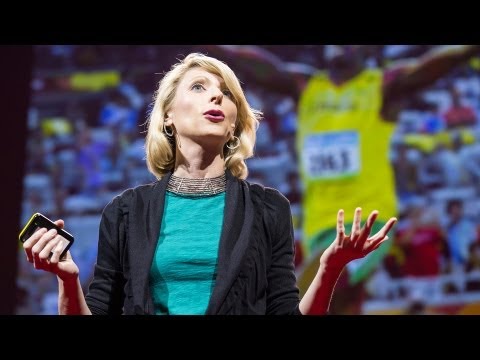
Your Body Language May Shape Who You Are | Amy Cuddy | TED
Sources named on screen: Ambady on physician lawsuits, Todorov on Senate races, Tracy on pride in blind athletes.
Caveat: Her own 2-minute pose study (hormones, 86% vs 60% gambling) is the base of the life-changing claim.
Key takeaways
- 11:21 The core result is her own lab study: 86% vs 60% gambled, testosterone +20% vs -10%, cortisol -25% vs +15%. No sample size is given.
- 12:28 The leap from a two-minute lab task to changing life outcomes is her extrapolation, not shown in the talk.
- 14:57 In the mock interview, posers were rated better on presence, with no effect on speech quality or qualifications.
- 2:28 The early studies (physician lawsuits, Senate races) concern how others judge us, not how posing changes us.
The video in brief
- 0:00 Cuddy offers a free posture change lasting two minutes. She asks the audience to notice how they hold their bodies now, and says they will come back to it.
- 1:02 She shows a handshake clip that sparked weeks of media talk. She cites Ambady on physician lawsuits and Todorov on Senate race predictions from faces.
- 3:32 She says nonverbals also influence ourselves. Power means expanding, powerlessness means closing up, in animals and humans. Tracy's work shows blind athletes also raise their arms in victory.
- 5:42 She notes that MBA students show a range of power nonverbals, linked to gender and participation, which counts for half the grade. She wonders if faking power could increase participation.
- 7:28 She argues bodies can change minds, as with smiling around a pen. Powerful leaders have high testosterone and low cortisol, and primates taking the alpha role show these shifts within days.
- 10:18 Participants held high- or low-power poses for two minutes. The high-pose group gambled more (86% vs 60%) and showed hormone changes in saliva samples.
- 12:51 She says media misread the work as advice to pose in front of interviewers. In a stressful five-minute mock interview, blind coders preferred high-power posers, citing presence rather than content.
- 15:39 She tells of her car accident, IQ drop and impostor feelings at Princeton, and of her advisor's push to fake it. A student later did the same, and Cuddy urges two minutes of posing before stressful moments.
What it's about
Amy Cuddy argues that holding open, expansive poses for two minutes changes hormones and confidence, and may help in stressful evaluations such as job interviews. She asks viewers to try it and share it.
What the video doesn't say
- No sample size or statistical detail is given for the pose experiments.
- No independent replication of the hormone and gambling results is mentioned.
- Effects shown last minutes in a lab; nothing on how long they hold in real life.
Claim map
Cited source: Nalini Ambady, Tufts University, named in the talk
Counter-argument: The study concerns observers' impressions. It supports the idea that nonverbals matter socially, but says nothing about whether posing alone changes how a person feels or acts.
Cited source: Alex Todorov, Princeton, named in the talk
Counter-argument: The figure is about how voters see faces. It does not show that posture affects the person who adopts it.
Cited source: Jessica Tracy, named in the talk
Counter-argument: An innate display after winning does not prove the reverse direction, that mimicking it without winning changes feelings or hormones.
Counter-argument: A single small study can overstate effects. The talk shows no sample size, no outside replication and no check that gambling reflects real-life risk-taking.
Counter-argument: Hormone levels in saliva fluctuate, and no outside study is cited. Showing short-term hormone shifts is not the same as showing lasting changes in how the brain copes with stress.
Counter-argument: The result comes from her own experiment with few raters. It does not show that posing before a real job interview changes hiring outcomes.
Counter-argument: The talk shows only short-term lab effects. No follow-up shows lasting benefits for people with little status, and she herself asks at 12:28 whether it can really change lives.
Interests at stake
No sponsor, affiliate link or creator product detected in the description or transcript.
No commercial interest detected: no sponsor, affiliate link or product. The talk gives the speaker credibility for her research.
Install Unsaid (free)